

Diversity & Inclusion
ALA Silicon Valley Chapter fosters an inclusive environment of awareness and respect.
Our Chapter continues to support the Association's Diversity, Equity, Inclusion, and Accessibility Statement. We provide education to legal industry leaders about why equity, inclusivity, and accessibility are important and how we can work to bring diversity, inclusion, and accessibility to the legal workplace.
|
"Diversity is about recognizing, respecting, and valuing differences based on ethnicity, gender, color, age, race, religion, disability, national origin and sexual orientation. It also includes an infinite range of individual unique characteristics and experiences, such as communication style, career path, life experience, educational background, geographic location, income level, marital status, military experience, parental status and other variables that influence personal perspectives. |
 |
|
These life experiences and personal perspectives make us react and think differently, approach challenges and solve problems differently, make suggestions and decisions differently, and see different opportunities. Diversity, then, is also about diversity of thought. And superior business performance requires tapping into these unique perspectives."1 1 Chubb Group of Insurance Companies, Business Case for Diversity Contact Us:ALA Silicon Valley Chapter Diversity and Inclusion Committee Also, ALA's Diversity, Equity, Inclusion and Accessibility Advisory Council continues to be a resource to you individually and to your firms, organizations, and chapters. |
|
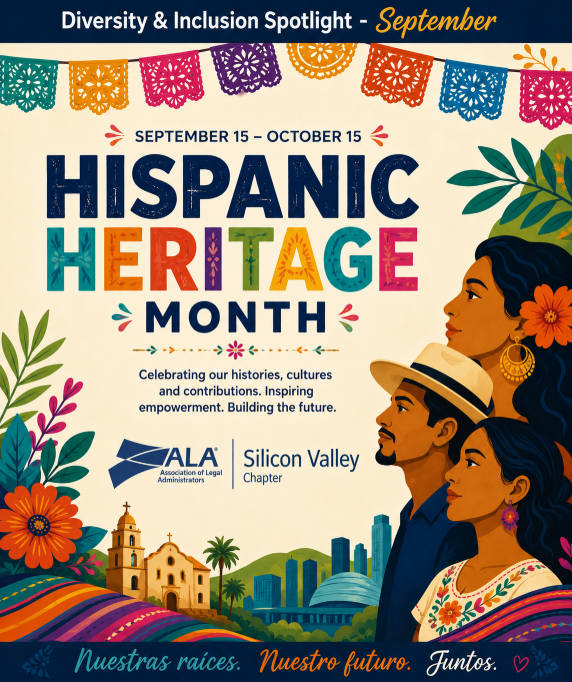
Diversity & Inclusion Spotlight - September 2026
Beyond the Celebration: Building an Inclusive Workplace During Hispanic Heritage Month
Each year, National Hispanic Heritage Month is observed from September 15 through October 15, recognizing the histories, cultures, and contributions of people whose heritage is connected to Spain, Mexico, the Caribbean, and Central and South America. For legal administrators and managers, this observance offers more than an opportunity to host a cultural event or share an educational message. It is also a timely invitation to examine whether our everyday workplace practices create meaningful opportunities for employees of all backgrounds to contribute, advance, and lead.
This work is especially relevant in Silicon Valley. Law firms and legal departments operate in a region shaped by global businesses, multilingual communities, and professionals with a wide range of cultural experiences. Our ability to attract talent, support employees and serve clients effectively depends, in part, on how thoughtfully we manage those differences.
Recognize the Diversity Within the Community
One of the first principles of inclusion is to avoid treating any community as a single, uniform group. The terms Hispanic, Latino, Latina, Latine, and Latinx may overlap, but they are not interchangeable for everyone. Preferences can vary according to nationality, generation, geography, and personal identity.
Managers do not need to master every term. They do need to respect how individuals identify themselves. Use the terminology an employee uses, pronounce names correctly, and avoid assumptions about someone's language abilities, family background, immigration history, or cultural traditions.
Small acts of respect can have an outsized effect on a sense of belonging. Taking the time to learn the correct pronunciation of a colleague’s name, for example, communicates that the person is seen and valued. Repeatedly shortening or changing a name for the convenience of others can communicate the opposite.
Examine Who Receives Opportunity
Legal organizations often evaluate inclusion by looking at hiring numbers. Recruitment is important, but representation alone does not demonstrate equity. Administrators and managers should also consider what happens after an employee joins the organization.
Who receives high visibility assignments? Who is invited to participate in client meetings, strategic projects, or leadership committees? Who is encouraged to pursue professional development? Who receives informal coaching and sponsorship from influential leaders?
These questions matter for attorneys and business professionals alike. Employees may technically hold the same title while receiving very different levels of exposure, responsibility, and access to decision-makers. Managers can reduce this disparity by establishing clear criteria for assigning work, discussing development goals during regular check-ins and monitoring whether opportunities are being distributed consistently.
Mentorship is valuable, but sponsorship is equally important. A mentor offers advice; a sponsor actively advocates for someone when an opportunity arises. Inclusive leaders do both.
Treat Language Skills as Professional Skills
Bilingual and multilingual employees can provide tremendous value to legal organizations. Their skills may strengthen client relationships, improve communication, and help colleagues understand cultural context. However, those employees can also become the default translators, cultural interpreters, or community representatives often without recognition, additional resources, or compensation.
Managers should not assume that an employee is comfortable conducting professional legal business in another language simply because the employee speaks that language socially. Legal interpretation and translation require accuracy, confidentiality, and specialized knowledge. Qualified language-access resources should be used when appropriate.
When employees are asked to use multilingual abilities as part of their work, organizations should consider how those contributions are acknowledged in workloads, performance evaluations, and compensation decisions. Language ability should be treated as a professional competency, not as an unlimited informal favor.
Make Cultural Recognition Meaningful and Voluntary
Hispanic Heritage Month programming can help employees learn from one another, but it should not place the burden of education on Hispanic or Latino colleagues. No employee should feel pressured to share a personal story, organize an event or speak on behalf of an entire community.
Consider inviting an outside speaker, partnering with a local cultural or legal organization, supporting a community initiative, or highlighting the work of Hispanic and Latino leaders in the legal profession. Employee participation should be welcomed, supported, and voluntary.
Food, music, and cultural celebrations can be engaging components of an event, but they should not be the entire substance of the organization’s inclusion efforts. The most credible recognition connects celebration with ongoing practices involving recruitment, advancement, compensation, leadership development, and community engagement.
A September Practice Check
This month, legal administrators and managers can select one workplace process to examine more closely. Review how stretch assignments have been distributed during the past six months. Ask employees whether multilingual responsibilities are appropriately recognized. Add name pronunciation guidance to onboarding materials. Evaluate whether professional development opportunities are communicated consistently. Identify a local Hispanic or Latino bar association, legal aid organization, or community group with which the organization could build a sustained relationship.
The goal is not to solve every inclusion challenge in September. It is to make one concrete improvement that continues after the observance ends.
Diversity and inclusion become credible when they are embedded in the way an organization operates. Legal administrators have significant influence over policies, budgets, hiring systems, professional development, vendor relationships, and workplace culture. By using that influence thoughtfully, we can help create legal workplaces in which cultural differences are respected, contributions are recognized, and every employee has a genuine opportunity to succeed.
Diversity Observances
|
|
Diversity Observances Calendar |
|
|
 |
Other News
|
03/08/2021 International Women's DayIn honor of International Women's Day, the SVC Leadership Board participates in the #ChooseToChallenge2021 campaign. Learn more: Women's History Month and International Women's Day 2021 |
|
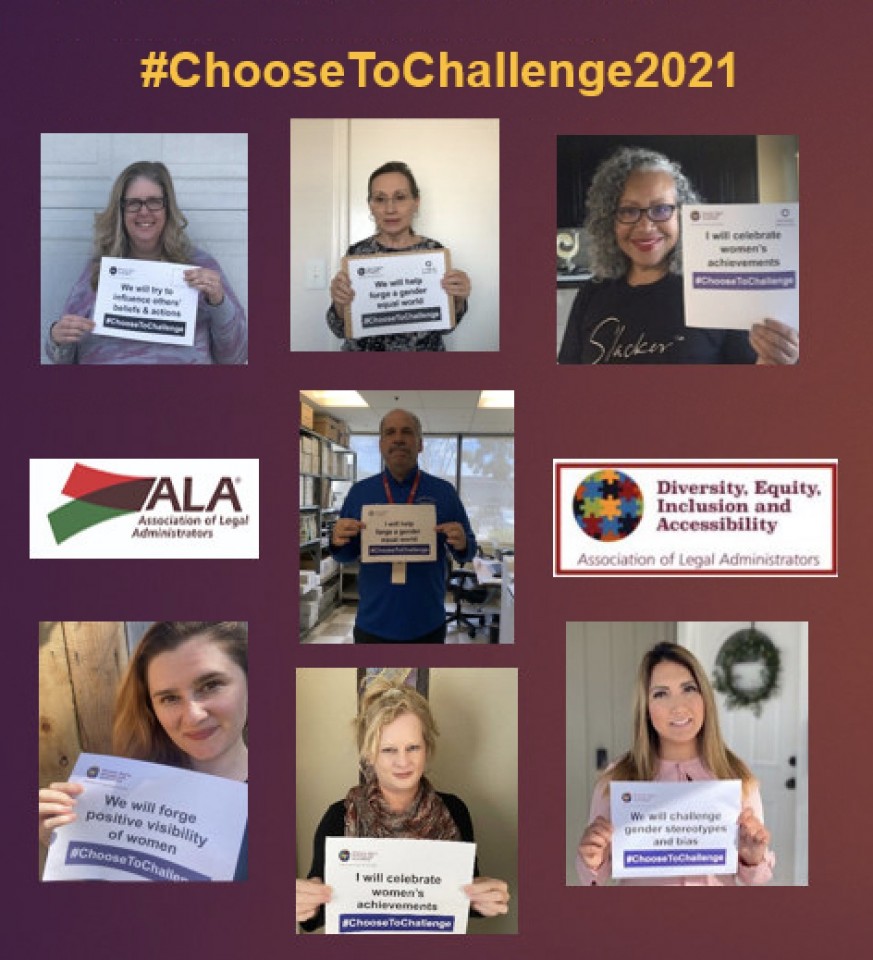 |
ALA SVC Leadership Pictured: Not pictured: |
06/08/2020, updated 07/10/2020
ALASVC's Statement of Solidarity with the Association's July 2020 Statement
ALA Silicon Valley Chapter supports the ALA Diversity Initiative's aim to increase awareness of and sensitivity to the differences among our workforce and to advance the concept of inclusiveness and acceptance. The Association of Legal Administrators calls upon our members and business partners and stakeholders to join us in the fight for equity and justice in America and across the globe. ALA stands in solidarity with our colleagues of color. The work to be done to dismantle systemic racism is immense. As individuals, and together as an Association, we all must do better.
You can read the Association’s full statement on recent events here.
5/09/2018
Video: What Does Diversity Mean To You
ALA's Diversity & Inclusion Committee developed a video featuring members talking about diversity and what it means to them. ALA's Committee for Diversity & Inclusion works to educate legal industry leaders about why diversity is important and how we can work to bring diversity and inclusion to the legal workplace.
Why Diversity?
The world is rich with our celebrations of diversity.
All employers should be able to create a diverse and inclusive work environment. Why? Because when business leaders and managers welcome many backgrounds, experiences, and viewpoints, they create a competitive advantage for themselves. But few organizations know how to create a culture that truly promotes, embraces, and seeks each employee's unique contributions. Gallup research, as noted in 3 Requirements for a Diverse and Inclusive Culture by Ella Washington and Camille Patrick has found that in a diverse, inclusive culture, three components must be present: “(1) everyone treats everyone else with respect; (2) managers appreciate the unique characteristics of everyone on their team; and (3) leaders do what's right.
Below is a list of resources gathered by ALASVC that we hope will be helpful to our members and the legal community to enhance diversity within our organizations.
Newsletters
RECOMMENDED READING by ALA Committee on Diversity and Inclusion
White Papers/Reports/Reference Guides
The Ripple, a newsletter by Ellie Krug
The Ripple contains stories about human kindness and compassion, and as well highlights some of the challenges that all of us face in our collective attempt to survive the Human Condition. Every issue also includes an “Inclusivity Tip” with ideas about how to make your organization (and personal life) more inclusive.
Articles
7 Ways to Practice Active Allyship by Poornima Luthra for Harvard Business Review, 11/08/2022
How to be your authentic self in the workplace (4 min read)
Inclusivity Tip: How to Foster Forgiveness in a Diverse Workplace
By Ellie Krug, June 23, 2017
Training
Free training hosted by Hollaback! and Asian Americans Advancing Justice (AAJC)
Education and Insight
ALA Brochure "Becoming An Advocate for Diversity and Inclusion"
About the County of Santa Clara
Compliance
US Department of Labor - Office of Federal Contract Compliance Programs (OFCCP)
US Equal Employment Opportunity Commission
Consultants and Speakers
Verna Myers "How to overcome our biases? Walk boldly toward them" [TED]
